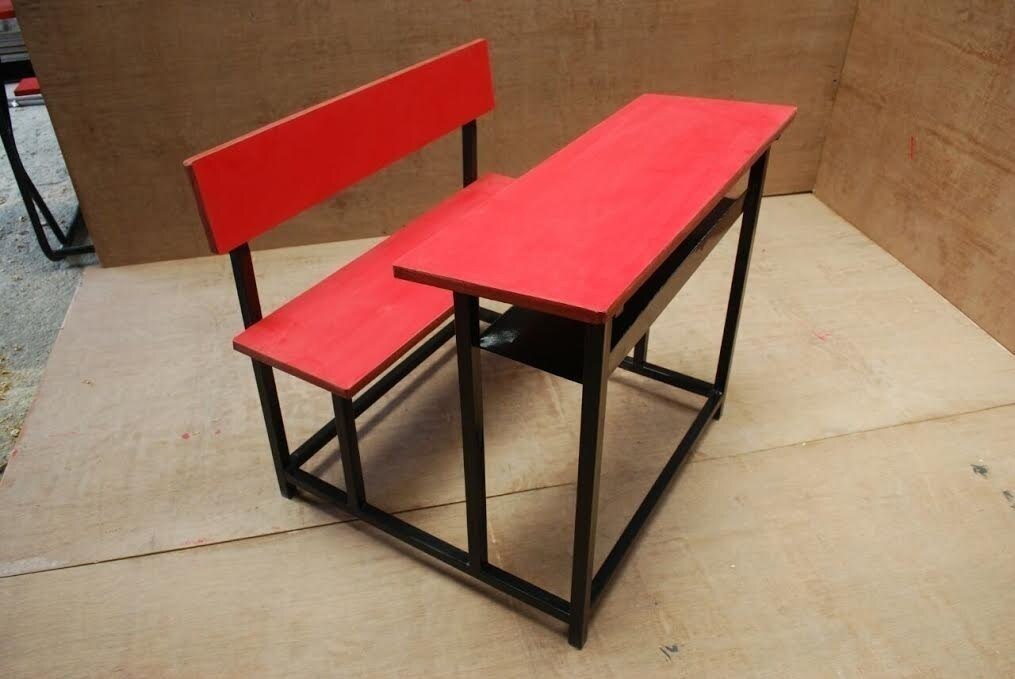
Crowded canteens lose usable seating to queues, door swings, oversized table footprints and aisles too narrow for children carrying hot food. You will be able to measure the room, compare layouts, specify safer tables and evaluate delivered wholesale cost before placing an order.
Key takeaways
- Measure usable floor area after clearance, queues, wash stations and emergency access.
- Keep queues out of seating aisles with one-way movement and clear door swings.
- Choose washable surfaces, sealed edges and frames that withstand daily cleaning.
- Compare delivered cost, installation, warranty and written specifications before ordering.
Calculate Usable Seating Before You Count Seats
Realistic canteen capacity means seats per square metre after tables, chair or bench clearance, queues, wash stations, drinking water, door swings and emergency access are included. The useful test for school furniture canteen tables for crowded seating is usable floor area, not the number of seats fixed to each table.
1. Draw the internal room dimensions, excluding wall thickness. An assumed 8 m by 6 m room contains 48 square metres before deductions.
2. Mark every fixed obstruction, including columns, sinks, wash stations, drinking-water points and equipment. Measure entry and exit doors in their open position, because a door leaf can remove seating and narrow an escape route.
3. Reserve the serving queue and circulation before placing tables. In the example, mark a 2 m by 3 m counter queue, equal to 6 square metres, and a 1.2 m by 2 m tray-return zone, equal to 2.4 square metres.
Keep the remaining space clear for movement and emergency access rather than treating it as table area.
4. Use masking tape to test table footprints, chair pull-out space and bench access on the floor. A two-sided table usually needs a 600–750 mm tabletop depth; reserve 900–1,200 mm for the principal serving or evacuation aisle, subject to the architect, local authority or fire consultant.
A “six-sitter” label is incomplete: ask whether it means three seats per side, end seating or compressed bench positions. A 1,200 mm table generally suits four comfortable seats; 1,500–1,800 mm can reach six, but long benches slow entry and exit.
Choose a Layout That Keeps Students Moving
Nominal seat count is not usable capacity. Long fixed six-seat tables trap students in the centre, obstruct end circulation and create bottlenecks, while two- and four-seat modules move easily for staggered lunch periods, examinations or events.
| Option | Strength | Main trade-off |
|---|---|---|
| Six-seat rectangular | Maximises seats in one footprint | Fixed benches hinder entry and exit |
| Two-sided bench table | Efficient shared dining | Middle users disturb others when leaving |
| Round table | Improves conversation and corner clearance | Uses wall space less efficiently |
| Wall-side counter | Supports one-sided dining | A 450–500 mm top is unsuitable for shared dining |
| Foldable table | Clears space for events and exams | Needs secure locks and planned storage |
| Linked modular units | Creates flexible grouped layouts | Connectors must release safely without tools |
Use round tables where corner clearance and conversation matter. Choose fixed six-seat tables only in wide rooms with stable age groups, little reconfiguration and adequate storage; they are the wrong choice for narrow rooms, mixed-age groups or frequent layout changes.
Keep service movement separate from seating movement:
- Leave the queue outside the seating grid for self-service.
- Give packed-meal distribution a direct path to the tables.
- Keep tray return and wash stations away from incoming traffic.
Reserve wheelchair places and extra legroom at table ends without narrowing the main aisle. If you buy school canteen tables wholesale, test the proposed layout with actual table footprints, including chair or bench clearance, rather than trusting the seat label.
Compare Benches, Chairs and Moveable Tables for Daily Use
Choose benches for maximum fixed capacity, separate chairs for individual access, and moveable tables only when staff can handle their storage and locking routine.
| Option | Seat turnover | Cleaning and movement | Accessibility and replacement |
|---|---|---|---|
| Bench seating | Slower exit; a child in the middle disturbs others | Fewer loose parts and faster floor cleaning | Specify 450–500 mm seat spacing and 350–450 mm bench depth; replace a whole unit if its frame fails |
| Separate chairs | Fast individual entry and exit | More clearance, scraping noise and misplaced chairs | Leaves a wheelchair position; replace one chair at a time |
| Moveable tables | Fast layout changes, not necessarily faster dining | Folding or nesting saves space but adds handling and cleaning points | Specify staff-safe release, storage and replacement of hinges, locks and connectors |
Check knee clearance, smooth undersides, stable feet, rounded corners and protection from finger pinch points. A 1,200 mm table commonly suits four comfortable places; do not create six by narrowing the top or compressing seat spacing.
Folding or nesting tables need hinges, locking devices, anti-collapse protection and a storage trolley when included. Linked modules need connectors staff can release without tools or unsafe lifting. Ask who moves them, how many staff are needed, where stacked units will stand and whether floor protection is supplied.
Pedestal bases improve leg access but require anti-tip and trip assessment; four-leg frames are easier to repair.
- Wipe tables after every lunch period.
- Inspect fasteners and welds weekly; dry-mop water immediately.
- Record damaged units before the next service.
Specify Surfaces and Frames for Food, Water and Heavy Use
A crowded-use table remains safe and cleanable only when its hidden construction is specified, not just its tabletop material. Inspect frame joints, welds, fasteners, tabletop edges, underside cavities, anti-tip stability, load-bearing behaviour and tube ends; projecting bolts, open tubes and trapped dirt are disqualifiers.
| Material | Maintenance and noise | Heat and corrosion | Repairability |
|---|---|---|---|
| Wood-based | Quiet, but damaged edges absorb water and need prompt sealing | Moderate heat resistance; moisture is the main failure | Replaceable top if fasteners remain accessible |
| Mild steel | Wipes easily; coating damage needs repair | Handles heat, but rusts where coating or tube ends fail | Welds and bolted parts are usually repairable |
| Stainless steel | Easy to inspect and sanitise | Type 304 suits greater food-acid and cleaning exposure; confirm grade | Bent or welded parts require specialist repair |
| Plastic | Quiet and easy to wipe; scratches retain soil | Heat resistance varies; no rust, but cracking occurs | Panels are replaceable only if proprietary parts exist |
For wood-based tops, require a moisture-resistant core, sealed edges and sealed screw penetrations. A decorative laminate on an exposed edge is not waterproof; request a repeated wet-wiping sample test.
For stainless steel, state the grade, sheet thickness and folded-edge construction, and identify whether the frame is stainless or painted mild steel. For mild-steel frames in Pune’s wet season, specify pretreatment, powder-coating details and capped or sealed tube ends.
Require rounded front corners, radiused edges, smooth undersides and stable adjustable feet. Ask a school furniture supplier in Pune for load testing and anti-tip evidence; cite EN 15372 only when tested, and EN 1729-1 only when designed to it. Confirm fire-egress and school-safety requirements with the architect, local authority or fire consultant.
Compare Suppliers on Delivered Cost and Written Proof
Compare every quote on delivered cost and identical written specifications, not on a low unit price.
| Quote area | Record from every bidder | Cost risk if omitted |
|---|---|---|
| Construction | Dimensioned drawing; overall and seat dimensions; tabletop material and thickness; frame section and gauge; weld or joint method; finish; coating; load rating; edge profile | Substitution, poor fit or early failure |
| Supply proof | Packaging, packing list, installation and delivery timeline; sample quality; warranty terms; replacement-part availability; references from crowded canteens | Delays, mismatched units or disputed repairs |
| Delivered price | Unloading, upper-floor access, assembly, floor levelling, floor protection, packaging removal, damaged-unit replacement and warranty call-outs | A cheap ex-works quote becomes expensive on site |
Ask whether a listing under school furniture dealers in Pune represents a manufacturer, stockist, dealer or project contractor. Identify who owns warranty responsibility and who can reproduce a matching unit.
For school canteen tables wholesale, confirm that every quoted unit has identical dimensions and materials. Record customization separately: length, depth, seat count, colour, tabletop material, frame finish and edge profile can each add drawing approval, sample review, production coordination and lead time.
Before signing, inspect doorways, stairwells, lifts and storage space, then agree phased placement inside the operating school. Evaluate Kohinoor School Furniture with the same evidence: site measurement, drawings, sample inspection, written specification, delivery scope and warranty—not catalogue labels alone.
Related products
 | Offering you a complete choice of products which include Six Sitter Canteen Table, Cafeteria Canteen Tables, Restaurant Canteen Tables, Office... View product → |
 | Size Customized Color Blue Design Type Customized Material Wooden We are offering School Furniture to our clients. View product → |
Frequently asked questions
How do you calculate usable seating in a school canteen?
Subtract tables, chair or bench clearance, queues, wash stations, drinking water points, door swings and emergency access from the total floor area. Count the seats that fit in the remaining usable area.
Which canteen layout keeps students moving?
Use a one-way route from entry to serving, seating, collection and exit. Keep queues outside seating aisles, preserve door clearance and avoid placing tables where they create crossing traffic.
Should a school choose benches, chairs or moveable tables?
Benches fit more students and reduce loose furniture, but they are less flexible during cleaning or events. Chairs improve individual access, while moveable tables support room reconfiguration but require storage and stronger handling controls.
What should school canteen tables withstand?
Specify non-porous, washable tops, sealed edges, corrosion-resistant frames and stable joints. Check resistance to water, food spills, repeated cleaning and heavy daily use.
How should you compare canteen table suppliers?
Compare delivered and installed cost, dimensions, materials, load details, warranty, lead time and replacement terms. Ask for written specifications, finish samples and proof of the supplier's business and tax details.
Related products
 | Color Blue Design Type Customized Material Wooden, MS We are offering Wooden School Furniture to our clients. View product → |
 | Providing you the best range of Student Single Desk Bench, MS Single Desk Bench and SS Single Desk with effective & timely delivery. View product → |
 | Being one of the leading manufacturers and suppliers of this commendable range of School Wooden Desk, we work hard to maintain its quality. View product → |
 | Size Customized Color Blue, Black Design Type Customized Material Plastic and MS We are offering School Class Furniture to our clients. View product → |