A furniture order can meet a nominal size and still leave pupils with unsupported feet, cramped knees, unstable desks or unsafe edges. By the end, you will have a room-by-room measurement method, a material and construction comparison, and an acceptance checklist you can use before approving a large delivery.
Key takeaways
- Record pupil stature ranges and specify the EN 1729-1 size marker.
- Choose benches, individual desks or chairs to suit room layout and teaching use.
- Name board materials, finishes, edge treatments and cleaning requirements in writing.
- Make the approved sample and inspection checks part of the purchase order.
Start with pupil stature, room use and measurable furniture sizes
Match each pupil’s stature to a desk-and-chair size, then test that combination in the actual room. For school class classroom furniture specifications in Pune, do not accept “standard size”: record the user’s stature range and specify the EN 1729-1 size marker.
EN 1729-2 provides useful safety and test criteria even when European certification is not required.
Measure the assembled sample, not just the catalogue drawing:
- Seat height: floor to the front edge of the seat; feet must rest flat without pressure behind the knees.
- Seat depth and width: support the thighs while leaving a small gap behind the knees.
- Desk height: floor to the working surface; elbows should remain near 90 degrees without raised shoulders.
- Tabletop size and legroom: record length, depth, knee clearance and the position of any bag hook or modesty panel.
Size the room around use, not furniture alone. Mark the full footprint on the floor, pull chairs out fully, add schoolbags and test the teaching aisle, door swing and access to storage. A full-size mock-up exposes obstructions before a bulk order.
| Room use | Check before approval | Failure to avoid |
|---|---|---|
| Individual work | One pupil per seat and clear chair pull-out | Crowded knees and blocked aisles |
| Group teaching | Joined working surfaces and movable chairs | Fixed benches preventing reconfiguration |
| Mixed-age class | Separate size markers or adjustable units | Smaller pupils’ unsupported feet |
| Covered open-sided room | Wet-cleaning clearance and corrosion exposure | Frames deteriorating during monsoon conditions |
Compare two-seater benches, individual desks and chairs by layout
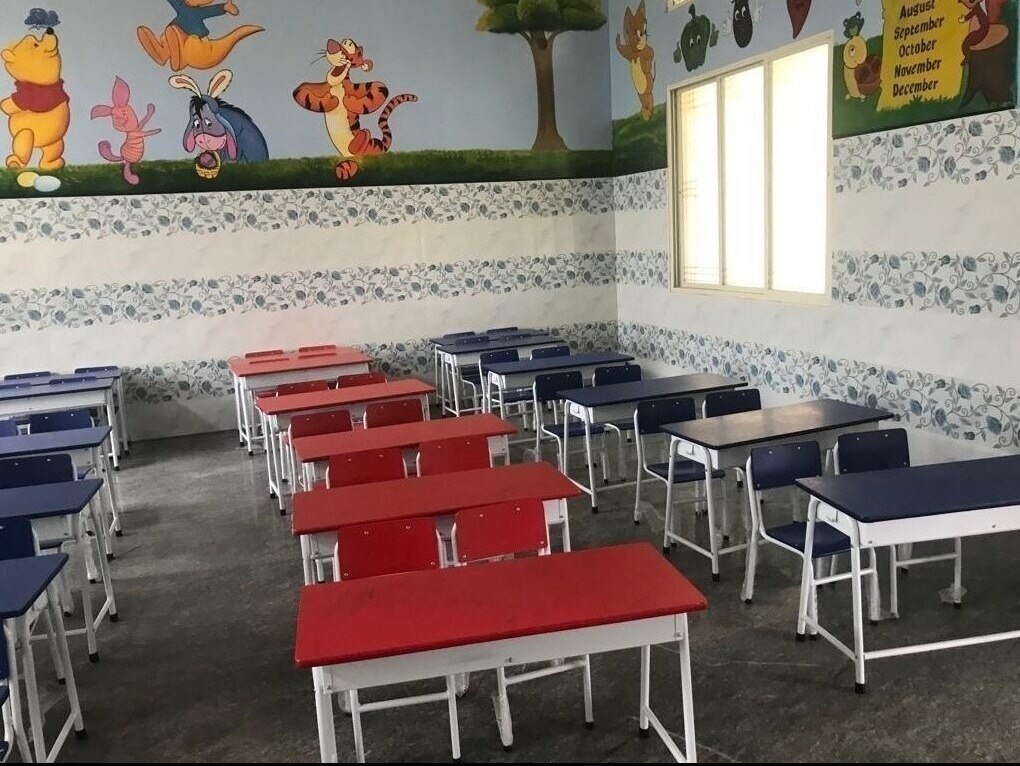
The right layout depends on the teaching pattern, room shape and pupil age—not simply on how many desks fit in a plan. Check the full footprint with chairs pulled out, schoolbags placed beside seats and a clear teaching aisle. Mark the arrangement on the floor or approve a full-size mock-up before ordering.
| Option | Best fit | Main limitation |
|---|---|---|
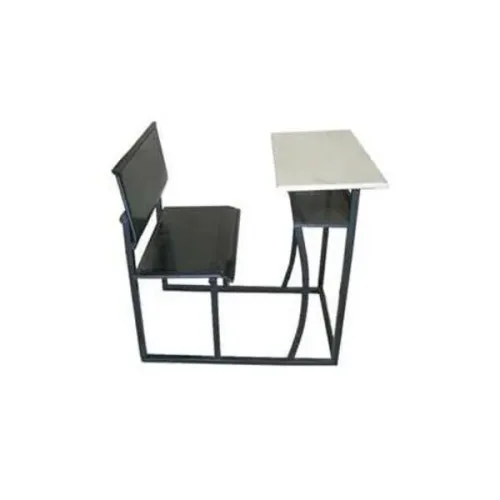
| Two-seater benches | Younger pupils, paired reading and narrow rectangular rooms with fixed forward-facing rows | One pupil’s movement disturbs the other; unsuitable for frequent group changes, mixed-age classes or independent assessment |
| Individual desks and chairs | Older pupils, examinations, lecture-style teaching and mixed-age rooms needing separate size adjustments | They consume more floor area and create more chair-pull-out space, especially around walls and storage |
| Individual desks with movable chairs | Activity-based teaching, workshops and rooms that change between rows, circles and groups | Reconfiguration takes time, and loose chairs increase collision, noise and bag-storage problems |
For classroom furniture details in Pune, match each desk and chair set to the approved pupil stature range. A bench sized for older children will leave younger pupils’ feet unsupported; a low set forces taller pupils to bend forward.
Use benches in long, regular rooms where the teacher mainly addresses the front. Choose separate units for irregular rooms, mixed-age classrooms or lessons that shift between individual, paired and group work. Test the chosen arrangement with actual circulation paths, not desk dimensions alone.
Specify materials, board construction and finishes by name
A purchase specification for school class furniture materials in Pune must name the core, thickness, edge treatment, frame section, fasteners and coating. “Wooden” does not tell you whether the panel is solid timber, plywood, MDF or particleboard; those choices differ in screw-holding, swelling, repairability and service life.
| Material | Specify by name | Check before approval |
|---|---|---|
| Plywood | Grade, thickness and moisture-resistant designation | No delamination at cut edges or screw points |
| MDF or particleboard | Board type, density, thickness and moisture-resistant grade | Reject swollen corners, crumbling holes or exposed core |
| Solid timber | Species, seasoned moisture content and joint method | Look for splits, loose knots and warping |
| Steel frame | Steel grade, tube dimensions and wall thickness | Confirm the stated section, not merely “metal” |
| Plastic component | Polymer type and UV-stabilised grade | Check brittleness, cracking and colour change |
List each exposed edge separately. Require 2 mm ABS or PVC edging, or properly bonded hardwood lipping, with rounded corners, no peeling strip and no open end grain. A sealed thinner panel can outlast a thicker panel with an exposed cut edge during Pune’s monsoon humidity.
Specify the finish as well as the substrate:
- Steel: zinc-phosphate pretreatment followed by powder coating, with colour and target coating thickness recorded.
- Board or timber: high-pressure laminate, melamine-faced surface, polyurethane or water-based coating, naming the sheen and cleanability requirement.
- Fasteners: stainless-steel or zinc-plated screws, captive nuts and tamper-resistant fittings where required.
Do not accept “fire resistant” as a material specification. If fire classification is required, name the test method and demand a report for the exact construction.
Check joints, welds, edges, stability and cleanability before delivery
A ready-for-use sample is inspected assembled, tested during normal movement and checked for defects that a teacher cannot repair on site. State whether dimensions are measured before or after edging; use one method consistently because edging changes usable tabletop size.
| Feature | Confirm at inspection | Reject if |
|---|---|---|
| Joints and welds | Tight joints; complete welds; no cracks, pinholes or sharp weld spatter | Joint movement, incomplete weld, exposed fastener or loose fitting |
| Edges and coating | Rounded, sealed edges; continuous coating; firmly fitted end caps | Sharp corner, delamination, blister, exposed board or missing cap |
| Stability | Level on the floor; stable during backward and sideways movement | Rocking, unequal legs, tipping or a loose adjustable foot |
| Cleanability | Smooth, wipeable surfaces; sealed joints; no dirt-trapping gaps | Open grain, rough welds, absorbent edges or inaccessible debris pockets |
Record these acceptance checks in the order:
- Set a maximum rocking movement in millimetres and a permitted leg-length mismatch. Reject desks or chairs beyond those limits rather than allowing a worker to wedge them level.
- Inspect underside frame joints, floor-contact points, fasteners, hollow-section interiors, cut edges and drilled holes for rust or missing corrosion protection. Pune’s monsoon and wet mopping expose these hidden areas first.
- Require captive or lockable adjustable feet. Ordinary loose screws can work out, become trip hazards and leave the frame unstable.
- Confirm that seat panels, back panels, glides and fasteners can be replaced with standard spares. A fully welded frame is rigid, but a damaged panel should not force complete replacement.
Turn the approved sample into an enforceable order checklist
Write every approved feature into the purchase order and acceptance sheet; “as per approved sample” alone is difficult to enforce. Use this classroom furniture order checklist in Pune:
1. Record class, pupil stature range, desk and seat size, tabletop length and width, seat depth, legroom, and teacher-desk dimensions. Cite EN 1729-1 size markers as a reference, and approve a full-size marked-floor trial showing chair pull-out space, schoolbag clearance and circulation.
2. Attach an identified, dated sample photograph and drawing. State whether dimensions are measured before or after edging, and require delivery samples to be inspected fully assembled.
3. Insert agreed numeric tolerances for every dimension, including leg-length mismatch and maximum permitted rocking. Reject furniture that exceeds those limits, has sharp edges, delamination, open board edges, peeling or visibly uneven coating, incomplete welds, missing feet or loose hardware.
4. Test an assembled desk for rocking and an assembled chair during normal backward leaning and sideways movement. Accept adjustable feet only when they are captive or lockable; loose adjusters become trip hazards.
5. Specify the rejection process: isolate failed units, record photographs and batch numbers, set a replacement deadline, and require reinspection before payment. Check ABS/PVC edging or hardwood lipping for bonded ends and sealed cut edges, especially before Pune’s monsoon.
Give Kohinoor School Furniture the signed schedule, drawing and inspection form rather than relying on a verbal sample approval.
Related products
 | Being one of the leading manufacturers and suppliers of this commendable range of School Wooden Desk, we work hard to maintain its quality. View product → |
 | Size Customized Color Blue, Black Design Type Customized Material Plastic and MS We are offering School Class Furniture to our clients. View product → |
Frequently asked questions
How should Pune schools choose classroom furniture sizes?
Measure pupil stature ranges, match each range to a desk-and-chair size, and record the EN 1729-1 size marker. Test the combination in the actual classroom.
What should schools compare when choosing benches, individual desks and chairs?
Compare each layout for capacity, aisle width, movement, storage, group work and cleaning access. Two-seater benches increase seating density, while individual desks offer more flexibility.
Which classroom furniture materials and finishes should schools specify?
Name the frame material, board construction, laminate or paint finish, edge treatment and cleaning requirements. Avoid accepting only the word “standard” in a quotation.
What should schools inspect before accepting classroom furniture delivery?
Check joints, welds, sharp edges, stability, surface damage, level feet and cleanability against the approved sample.
How can a school make its classroom furniture order enforceable?
Attach the approved sample reference, dimension schedule, EN 1729-1 size marker, material and finish names, inspection criteria, delivery quantities and rejection terms to the purchase order.
Related products
 | Pioneers in the industry, we offer Nursery Class School Furniture Set, Pre-Primary School Furniture Set, Nursery Classroom Furniture, School Class... View product → |
 | Size Customized Color Blue Design Type Customized Material Wooden We are offering School Furniture to our clients. View product → |
 | School Furniture Nursery Class School Furniture Set Size Customized Color Yellow Design Type Customized Material Wooden Chair 2 Table 1 We are offering Nursery Class School Furniture Set to our clients. View product → |
 | Product Details: Size Customized Color Cream Design Type Customized Material Wooden Weight 5-6 kg We are offering Pre-Primary School Furniture Set to... View product → |