A college buying team may have the rooms, budget and procurement process to purchase benches, but younger primary pupils need furniture sized around their bodies rather than the institution’s adult facilities. By the end, you will be able to specify dimensions, choose a seating format, test a sample and plan a layout that supports safe teaching, movement and maintenance.
Key takeaways
- Measure pupils before selecting bench height and seat depth.
- Specify rounded edges, stable frames and easy-clean surfaces.
- Compare two-seat benches with individual desks for supervision and movement.
- Test a sample in the intended classroom before placing the full order.
Translate a college purchase into a primary classroom specification
Do not buy an adult bench relabelled “primary.” Define educational furniture for primary benches by the pupil fit, tested configuration and classroom conditions the college actually needs.
Treat educational furniture for schools as a measured specification. Require the quotation to state the EN 1729-1 size mark, seat height, seat depth, writing-surface height, underside clearance and bench length. “Suitable for primary” is not a dimension.
- Specify the chair and bench as one set: pupils’ feet must rest flat, knees should sit near a right angle, thighs need clearance beneath the surface, and the writing top should sit close to elbow height.
- Offer more than one EN 1729-1 size mark when measurements show that one class includes substantially different pupil heights. A year-group label cannot reveal those differences.
- Request a pre-award sample in the intended room, loaded with real schoolbags and used with the proposed desk spacing. Check circulation, bag interference, chair noise, floor stability and cleaning access.
- Inspect exposed edges, undersides, rear corners and seat-to-frame joints for radiused edges, flush fasteners, shear points and finger traps. A smooth front edge alone proves little.
- Ask for EN 1729-2 conformity evidence covering the exact bench length, frame, fixing method and chair pairing offered. A certificate for a similar-looking product does not cover a different configuration.
This turns a college catalogue purchase into educational furniture for primary benches that can be checked against children, rooms and daily use before the order is placed.
Choose dimensions by pupil fit, not by year-group name
A size-2 bench may suit a younger primary pupil, while a taller classmate needs size 3 or 4. Do not assign furniture from the year-group label: measure representative pupils and match the complete chair-and-table set to EN 1729-1 size marks.
| Size mark | Seat height | Table height | Check before approval |
|---|---|---|---|
| 2 | About 31 cm | About 53 cm | Confirm seat depth, knee room and foot support |
| 3 | About 35 cm | About 59 cm | Useful for taller primary pupils; test thigh clearance |
| 4 | About 38 cm | About 64 cm | Use only when pupils can sit with feet supported |
These figures are starting points, not a substitute for a sample. Ask the supplier to state the EN 1729-1 mark, seat depth, table underside clearance and writing-surface dimensions on the quotation.
Educational furniture for primary benches fails when a correctly sized seat is paired with a table that leaves raised shoulders, unsupported feet or trapped thighs.
Test the proposed educational furniture for schools with pupils, bags and the intended floor spacing. Keep a position only if:
- Feet rest flat, with knees close to a right angle.
- Thighs clear the underside without pressure.
- Elbows sit near the writing surface without lifted shoulders.
- The seat supports the thighs without pressing behind the knees.
- A pupil can enter, write, stand and leave without moving another child.
A sloped writing surface can support handwriting, but test the proposed angle with pencils, books and tablet use before ordering. Choose separate size groups or adjustable modules when one bench size cannot meet these checks.
Compare seating formats, materials and construction details
Choose a single bench where pupils need frequent movement, wheelchair transfer or differentiated seating. Choose a two-seater for a practical balance between floor-space efficiency and individual access. Use a multi-seater only when high seating density matters and the room can support fixed spacing and supervision.
| Option | Strengths | Choose when |
|---|---|---|
| Single bench | Easy entry, spacing and rearrangement; one pupil leaving does not disturb others | Access, individual work or mixed-size pupils matter |
| Two-seater bench | Efficient without creating a long obstruction; supports paired work | Most primary classrooms with regular movement |
| Multi-seater bench | Highest seating density and fewer components | Stable groups, ample circulation and controlled seating |
| Wood construction | Warm appearance and straightforward repair; inspect edges, joints and splinters | You want a traditional classroom finish and can maintain the surface |
| MS frame | Mild-steel frames provide economical structural support; check powder-coat coverage and welded joints | Everyday institutional use with a controlled budget |
| Stainless-steel frame | Strong corrosion resistance and easy cleaning; costs more and can transmit noise | Damp cleaning regimes or heavy-use rooms |
| Single desks | Maximum spacing, ownership and rearrangement | Pupils need independent work, clear access or varied layouts |
| Chair-and-desk sets | Easier to match seat height, table height and clearance as one unit | You need consistent posture and quick room reconfiguration |
Long benches need more than a short sample’s approval. Require the tested maximum length, loading configuration and evidence that seat-to-frame joints resist deflection, loosening, rocking and tipping under uneven loads.
Ask a primary classroom furniture supplier to quote the EN 1729-1 size mark, seat height, seat depth and table clearance. Test a sample with bags, cleaning equipment and uneven floors; catalogue images will not reveal blocked circulation or noisy, unstable feet.
Write safety, hygiene and durability into the purchase order
Put acceptance criteria in the purchase order, not in a product photograph. Ask the primary classroom furniture supplier to identify the EN 1729-1 size mark and key dimensions for the complete chair-and-bench set; “primary” alone is not a usable specification.
1. Require EN 1729-2 evidence covering the exact bench length, frame, fixing method and configuration quoted. Check strength, stability and durability test results for that model, not a similar-looking product.
2. Inspect every exposed edge, underside, rear rail and seat-to-frame junction. Specify radiused edges, flush fasteners, secure joints and no accessible shear points or finger traps. Unprotected sharp corners and loose caps are rejection defects.
3. Specify smooth, sealed, non-absorbent work surfaces that tolerate the cleaning products used on campus. Require wipe-clean joints, corrosion-resistant hardware where wet cleaning occurs, and no gaps that trap food, dust or disinfectant residue.
4. Test the chair and bench together. Confirm flat feet, near-90-degree knees, supported thighs, adequate underside clearance and a writing surface near elbow height; a correctly sized bench paired with the wrong chair still causes strain.
5. Include accessible positions with clear knee and toe space, an accessible approach and a suitable surface height. Coordinate their number and location with the building’s accessibility plan and pupil needs.
6. Run a pre-award sample in the intended room with real bags, cleaning equipment, floor tolerances and proposed spacing. Kohinoor School Furniture can be assessed against these same checks rather than judged on finish alone. Reject samples that block circulation, rock, trap bags or create excessive chair noise.
Related products
 | Product Details: Size Customized Color Cream Design Type Customized Material Wooden Weight 5-6 kg We are offering Pre-Primary School Furniture Set to... View product → |
 | Providing you the best range of MS Single Desk Bench, SS Single Desk and Student Single Desk Bench with effective & timely delivery. View product → |
Arrange benches for visibility, supervision and daily movement
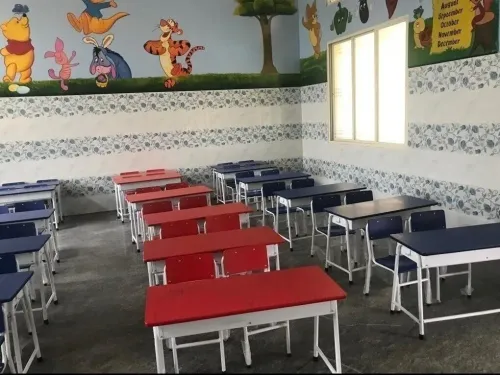
Use paired bench rows with a clear central aisle when teaching requires direct sightlines, quick supervision and orderly evacuation. Keep the teacher’s route to every row open; a dense grid that looks efficient on a plan becomes difficult when pupils carry bags or one child needs assistance.
| Layout | Teaching and movement benefit | Main limitation |
|---|---|---|
| Paired rows | Strong forward visibility, simple supervision and predictable exit routes | Limited face-to-face collaboration |
| Small clusters | Supports group work while keeping defined access spaces | Pupils may turn away from the teacher |
| U-shape | Gives the teacher a clear view and creates a shared discussion area | Uses more floor area and can narrow corners |
| Individual desks or bench modules | Allows wheelchair approach, differentiated seating and easier pupil exit | Requires more planning and usually reduces seating density |
For educational furniture for primary benches, mark an aisle at the room’s busiest points, not only between furniture rows. Leave enough clearance for a pupil to pull out without striking the next bench, and keep bags out of evacuation paths.
Check the proposed educational furniture for schools in the actual classroom with:
- Real bags, chairs and cleaning equipment
- A wheelchair-accessible position with clear knee and toe space
- An unobstructed route to each exit
- Sightlines from the teacher’s position to every pupil
Test a pre-award sample on the real floor. Uneven surfaces, noisy movement and blocked circulation will not appear in catalogue photographs.
Frequently asked questions
How should a college translate its purchase into a primary bench specification?
Define the pupils’ height range, seating capacity, bench dimensions, materials, classroom conditions, cleaning routine and expected service life. Request a drawing or sample that shows the complete bench configuration rather than accepting an adult bench labelled for primary use.
How do you choose primary bench dimensions?
Measure pupil fit directly. Check seat height, seat depth, tabletop height, knee clearance and foot support against the children who will use the benches. Do not select dimensions from the year-group name alone.
Which seating formats and materials should colleges compare?
Compare two-seat benches, shared tables with separate chairs and individual desks. Assess how each format affects posture, supervision, movement, cleaning and storage. Compare laminate or coated board surfaces with solid timber or metal components for moisture resistance, repairability and long-term durability.
What safety, hygiene and durability details belong in the purchase order?
Specify rounded or radiused edges, covered fasteners, stable frames, non-snagging feet, wipe-clean surfaces, moisture-resistant finishes, replacement parts and cleaning instructions. State the required load, finish, dimensions and inspection method in writing.
How should colleges arrange benches in a primary classroom?
Keep every pupil within the teacher’s sightline, preserve clear routes to the entrance and teaching area, and leave enough space for pupils to sit, stand and move without striking nearby furniture. Test the layout with the actual benches before final installation.
Related product
 | Being one of the leading manufacturers and suppliers of this commendable range of School Wooden Desk, we work hard to maintain its quality. View product → |