A canteen order can fail before delivery if it is based only on the number of seats or a catalogue photograph. Start with a measured room plan, convert meal demand into a seating capacity, then compare construction details, cleaning performance, installation terms and acceptance conditions before issuing a purchase order.
Key takeaways
- Send a measured layout and bill of quantities before requesting prices.
- Calculate seats from table dimensions, aisle widths and service-counter traffic.
- Compare laminate, stainless steel and compact laminate surfaces for hygiene and upkeep.
- Approve drawings, materials, quantities and delivery terms in the purchase order.
Measure the Canteen Before You Ask for Prices
Send a measured layout and bill of quantities, not just a seat count. The practical answer to how to order school canteen tables in Pune is to show the supplier what can fit, where people move and how the room operates.
- Record the room’s length and width, wall clearances, columns, floor levels and any obstructions.
- Mark every door, door swing, emergency exit, lift dimension and the route from unloading point to the dining area.
- Locate the serving counter, queue line, wash area, handwashing points and cleaning-equipment storage.
- State the required seats per sitting, student age groups, daily meal periods and expected seating cycles.
- Identify wheelchair-compatible places and preserve a continuous approach route without narrowing the main aisle or trapping users in the queue.
- Note supervision points so staff can see occupied tables and movement through the room.
- Specify the bill of quantities by table type, dimensions, seat arrangement and required installation location.
Do not describe a table as a “four-seater” and leave it there; a nominal four-seater can collide with a column or block a door. Your brief for school furniture for canteens should also request rounded exposed edges, stable non-tipping frames and no sharp projections.
If folding or knock-down legs are proposed, ask the supplier to identify hinge points and fasteners for inspection.
Calculate Seating Capacity and Draw the Traffic Routes
Order by measured layout and bill of quantities, not by a target such as “200 seats.” A nominal four-seater can fail to fit once you account for columns, counter depth, door swings, cleaning access and circulation. Calculate the usable dining area after removing those fixed obstructions.
- Record the peak diners expected in one lunch period, then divide by the number of seating cycles. For example, 240 diners served across three cycles require 80 seats available at one time.
- Test each table size against its actual seat count. Include table length, end clearances and the space needed to pull out chairs; do not count a seat that blocks an aisle.
- Mark wheelchair-compatible positions with a clear approach, usable table height and a continuous route to the dining area. Keep these places out of the serving queue and do not let chairs reduce the main aisle below the project’s accessibility requirement.
- Draw the bill of quantities from the approved plan: table type, dimensions, quantity, seats, accessible positions and any wall or floor fixing.
Draw arrows for the route from entry to queue, serving counter, seating and exit. Keep the queue separate from occupied tables, preserve staff sightlines, and never place furniture across an emergency exit or its approach. Canteen tables for educational institutions need stable, non-tipping geometry, rounded exposed edges and no sharp projections.
Check foldable or knock-down legs for loose fasteners and hinge pinch points before approval.
Compare Table Types, Materials and Hygiene Details
Choose construction by the cleaning regime and failure points, not by appearance. For most dining rooms, welded frames and sealed, smooth tops outperform decorative or heavily jointed designs.
| Construction | Cleaning and durability | Noise, corrosion and repair |
|---|---|---|
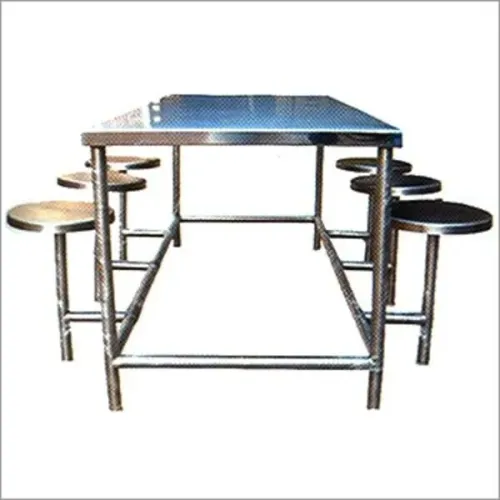
| Welded stainless-steel top and frame | Non-absorbent, impact-resistant and easy to sanitise; specify the stainless grade, sheet thickness and finished welds | Low joint movement and fewer loose parts; ask about tube gauge, dissimilar-metal contact and chlorinated cleaners |
| Compact laminate top on a powder-coated steel frame | Smooth, sealed and easier to replace than a welded top; protect every cut edge | Rubber feet reduce scraping noise; chipped coating exposes steel and needs prompt repair |
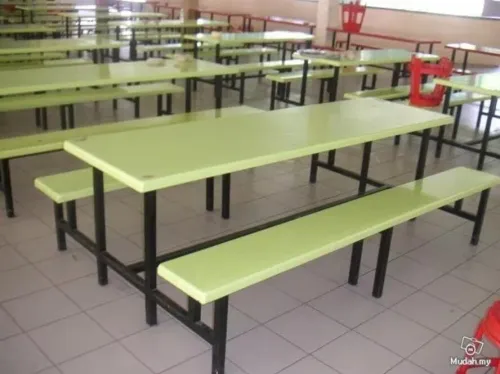
| Foldable or knock-down frame with laminate or steel top | Convenient for storage, but hinges, bolts and open joints trap food and loosen under heavy use | Quiet only with maintained feet and fasteners; inspect hinge pins, accessible screws and replacement-part availability |
For school furniture for canteens, require radiused exposed edges, stable non-tipping geometry and no sharp projections. Reject open screw heads, deep decorative grooves, raw plywood edges and unsealed junctions: each retains food debris or absorbs wash water.
Do not give a dining table the specification for a preparation counter. Specify food-contact-grade material and a sealed wall junction where food is handled; dining tables need cleanability, stability and impact resistance. Canteen tables for educational institutions also need accessible approach space and clear routes, not merely a stated seat count.
Demand a Technical Submission, Not Just a Unit Rate
A quoted size and per-unit price do not reveal whether two tables are equivalent. Require a canteen table supplier in Pune to submit a dimensioned drawing and a technical schedule before commercial bids are opened; otherwise thinner sheet, weaker welds, unsealed edges or excluded installation can win on price.
Request these details for every model:
- Overall length, width and height, tabletop thickness, seat height, seat spacing and clear knee space
- Tabletop and frame material, stainless-steel grade, nominal sheet thickness, tube size and tube gauge
- Edge profile, radius, folded edge or trim, and whether board or laminate edges are sealed
- Underframe layout, leg positions, cross-bracing, adjustable feet, weld finish and floor-protection details
- Surface finish, cleanability, resistance to chlorinated cleaners, and protection against dissimilar-metal corrosion
- Delivery lead time, installation method, anchoring requirements, packaging removal and warranty coverage
| Comparison point | Evidence to demand | Risk if omitted |
|---|---|---|
| Overall dimensions | Dimensioned elevation and plan showing clearances, seat spacing and accessible approach space | Tables reduce aisle width or leave wheelchair users without a usable position |
| Stainless construction | Grade, thickness, tube gauge, weld photographs or finish description | A stainless appearance conceals thin sheet, rough welds or corrosion-prone contacts |
| Installation and acceptance | Assembly drawing, site method, tolerances and damage-replacement terms | Delivered tables are treated as accepted despite wobble or installation damage |
Keep the specification brand-neutral for GeM, institutional quotations or Maharashtra e-tendering, and compare measurable construction rather than product names.
Turn the Approved Drawing into a Controlled Purchase Order
Do not release payment on a quoted unit rate alone. Convert the approved drawing, bill of quantities and technical submission into a purchase order that controls what arrives, how it is installed and what counts as acceptance.
1. Attach the approved dimensioned drawing and bill of quantities. Identify each table by length, width, height, seat count, material, edge radius, underframe, finish and location. Include wall clearances, serving counter, aisles, cleaning access, door swings and wheelchair-compatible positions.
2. Record the supplier’s delivery lead time, packing method, unloading point, installation access and consignee inspection date. State who removes packaging and where damaged goods must be reported. For GeM or a formal tender, put delivery, inspection, installation, warranty and payment milestones in the bid itself.
3. Make the canteen table supplier in Pune confirm construction details in writing: permitted dimensional tolerance, no sharp projections, stable non-tipping geometry, sealed edges, weld quality and corrosion-resistant finish. Specify anchoring where required, and inspect foldable legs, hinges and fasteners for looseness.
4. Separate product acceptance from installation acceptance. The first confirms dimensions, finish and absence of dents, rocking or wobble; the second confirms assembly, anchoring, route clearance and site cleanliness. Require replacement of defective or transit-damaged parts, not an improvised repair.
5. Hold the final payment until both acceptance records are signed and the warranty documents are received. This is a practical safeguard in how to order school canteen tables in Pune; Kohinoor School Furniture can be evaluated against the same drawing-and-acceptance controls as every competing supplier.
Related product
 | Offering you a complete choice of products which include Six Sitter Canteen Table, Cafeteria Canteen Tables, Restaurant Canteen Tables, Office... View product → |
Frequently asked questions
What should you measure before asking for school canteen table prices?
Measure the room length and width, columns, doors, windows, service counters, hand-wash points and fixed equipment. Mark these on a scaled layout and include a bill of quantities.
How do you calculate seating capacity in a school canteen?
Start with the table dimensions and intended seats per table, then reserve clear routes to entrances, exits, counters and hand-wash areas. Do not fill the room using seat count alone.
Which canteen table materials should educational institutions compare?
Compare the tabletop surface, edge treatment, frame material, fasteners and cleanability. Check whether each option resists moisture, food stains, impact and frequent cleaning.
What should a supplier's technical submission include?
Request a dimensioned drawing, table schedule, material specifications, edge and frame details, finish, quantities, delivery scope, installation method and warranty terms.