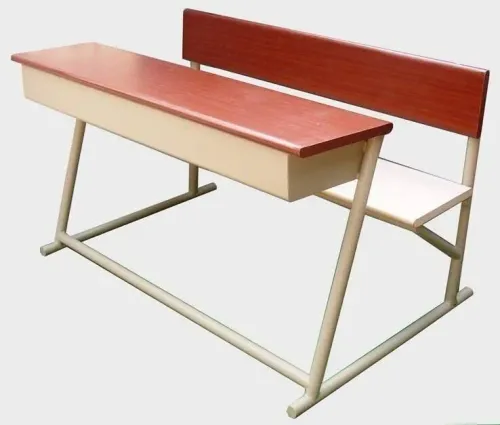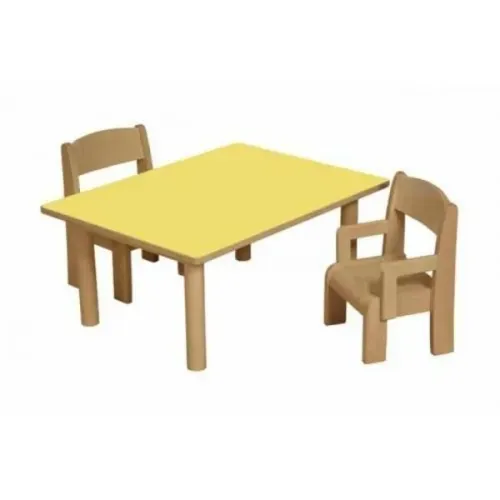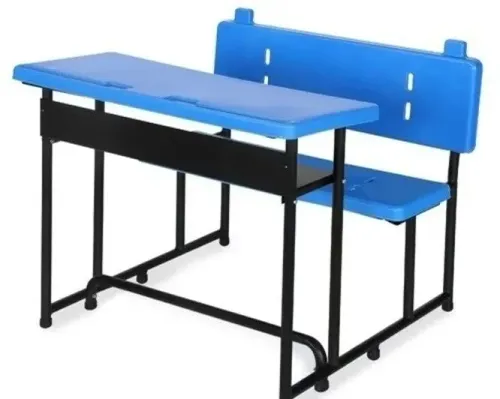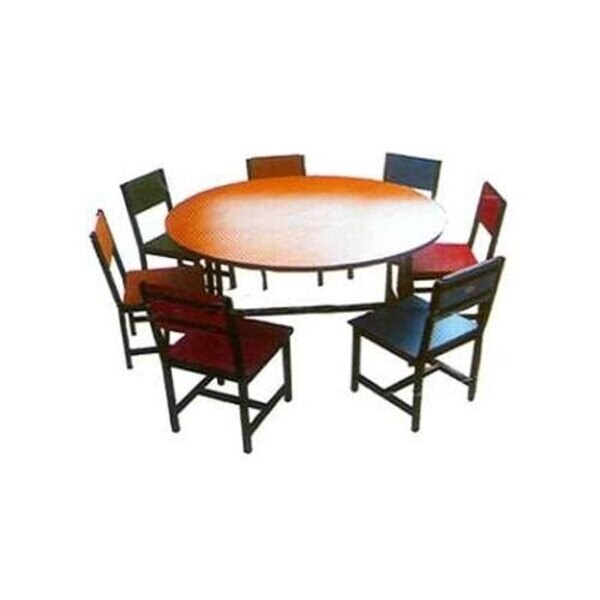
A fixed boardroom-style table can consume the floor area needed for lessons, examinations and storage. By comparing table formats, measuring the complete room layout and specifying the right hardware, you can select a meeting surface that works as teaching furniture rather than becoming a permanent obstacle.
Key takeaways
- Choose two linked rectangular modules for meetings, lessons, exams and storage.
- Measure doorways, circulation paths and stacked storage space before ordering.
- Allow about 600 mm of tabletop edge per seated adult.
- Compare frame strength, edge protection, cable access, castors and knock-down fittings.
Which conference table format works in a small school classroom?
Two linked rectangular modules usually suit a small classroom better than a fixed eight- or ten-seat table because you can join them for meetings and separate them for lessons, examinations or storage.
A school conference table supports staff meetings, parent discussions, teacher training and group work around a shared surface.
It differs from a classroom bench, which faces forward for instruction; a staff-room table, which is a general-purpose work surface; a meeting table, which may assume occasional adult use; and a canteen dining table, designed for meal circulation and cleaning.
For conference table options for Pune schools, compare formats by both use and storage:
| Option | Main advantage | Main limitation |
|---|---|---|
| Folding, nesting or flip-top | Packs away or stores vertically; flip-top units nest closely | Folding units need more handling and alignment |
| Modular rectangular | Packs tightly against walls; supports straight rows | Less naturally collaborative without joining |
| Trapezoid or wedge | Joins into collaborative clusters or separates into stations | Awkward against straight walls |
| Round or boat-shaped | Improves conversation and sightlines | Wastes space at the ends and is harder to store |
Request rectangular modules around 1,200–1,500 mm long and 600–750 mm deep; these are practical specifications, not universal standards. Conference tables for educational institutions are the wrong choice when meetings are rare and every square metre is needed for lessons, examinations or equipment. Linked classroom tables will then provide more useful flexibility.
How do you test whether a conference table fits the room?
Test the complete furnished arrangement, not the tabletop alone. A conference table Pune school planners can use successfully must leave room for people, teaching, storage and movement.
1. Measure the clear room length and width. Mark the tabletop, chair pull-out zones, teacher access, walking routes, door swings, cupboards, electrical points and storage clearance on the floor with tape.
2. Allow about 600 mm of table-edge length per seated adult before counting end seats. Pull every chair out fully and check that it does not block the door or the route to the board.
3. Mark at least one accessible position and measure knee clearance beneath it. Use U.S. ADA 2010 benchmarks as a planning reference: 760 mm minimum knee-clearance width, 685 mm height, 485 mm depth and 1,525 mm turning space. Confirm Indian project requirements separately; ADA is not Indian law.
4. Test storage geometry. A folded or nested table must pass through the classroom door, corridor, staircase and lift, so record packed dimensions in older Pune buildings.
5. Build a full-size cardboard mock-up with chairs. It exposes conflicts before procurement.
One compact table can remain assembled for staff meetings. Two linked modules can separate into group-work stations. Nesting or folding tables can move against a wall after a lesson, restoring teaching space. Measure with chairs in place, not an empty table.
How many people can each tabletop actually seat?
Allow approximately 600 mm of table-edge length per adult. A 1,200 mm rectangular module normally seats two people on one long side; a 1,500 mm module seats two to three. Count end seats separately because they reduce circulation and knee space.
A four-leg frame can occupy the exact position needed for a child’s knees, while a pedestal frees edge legroom but can obstruct wheelchair positioning, bags or feet at the centre.
| Option | Stability | Setup speed | Floor protection | Storage demand | Movement noise |
|---|---|---|---|---|---|
| Fixed base | Highest | Slowest to rearrange | No caster marks | Permanent footprint | Minimal |
| Movable, lockable casters | Stable with positive brakes | Fast | Check wheel and brake quality | Needs parking space | Higher during movement |
| Nesting or folding | Depends on locked frame | Fast after practice | Check repeated folding points | Compact when nested | Frame and wheel noise |
For conference tables for educational institutions, state whether the room serves early-years pupils, older students, staff or mixed groups. Do not copy an adult boardroom height of roughly 720–750 mm without checking chair seat height and age range; adjustable-height tables or separate height bands may fit better.
- Include power modules, cable boxes, thick end panels and large corner radii in the seat count; each can remove a usable position.
- Specify connectors that resist both edge separation and height mismatch between linked tops. Casters alone cannot prevent drifting or uneven surfaces.
- Test every intended seat for knee clearance, wheelchair access, bags and feet before accepting the advertised capacity.
Which construction details should you compare before requesting a quote?
Ask for the exact construction, not “heavy-duty” furniture. Your school conference table supplier Pune shortlist should state whether each model has folding legs, lockable casters, a nesting frame or a fixed base, and how many staff members can move it safely.
| Option | Movement and storage | Check before quoting |
|---|---|---|
| Folding legs | Folds for wall or store-room storage | Leg locks and safe handling count |
| Lockable casters | Rolls between layouts | Positive brake holds under load |
| Nesting frame | Tables slide together compactly | Nested depth and frame clearance |
| Fixed base | Stable, permanent setup | Delivery route and floor protection |
For joined units, request the linking hardware and test whether it prevents lateral drift and height mismatch. Specify tabletop thickness, substrate, frame material, static-load rating, edge banding and finish. In Pune’s monsoon, call laminate-faced engineered board moisture-resistant or suitable for humid conditions, never waterproof.
Protect cut-outs, screw holes, joints and exposed board edges; sealed edge bands and protected cable openings matter more than laminate brand.
A grommet, under-table tray and vertical cable spine route cables only. Sockets, earthing and circuit protection belong to the responsible electrical contractor. Choose knock-down construction for narrow routes, but require factory-installed threaded inserts or metal-to-metal fasteners, retightening instructions and replacement hardware.
Before approval, inspect a full-size mock-up with the actual chair, connector, caster brake, storage position and cable route. Photographs cannot expose sharp underside hardware, unstable joins or brakes that fail under load.
How should a Pune school compare suppliers and choose the right arrangement?
Turn the chosen use case into a purchase brief: state whether the units will serve lessons, parent meetings, examinations, teacher training or storage between classes. For conference table options for Pune schools, attach the room plan and require a full-size mock-up with the actual chairs, links, caster brakes, storage position and cable route.
Request these details in writing:
- Dimensional drawing, tabletop thickness, substrate type, edge treatment, frame material and finish
- Static-load rating, caster specification, joining method and packed dimensions
- Replacement-part availability for casters, links, fasteners and damaged edge bands
- Separate prices for the table, linking hardware, storage trolley, cable-management parts, delivery and installation
Compare capability, not catalogue photographs.
| Supplier type | Strength | Risk to check |
|---|---|---|
| Manufacturer | Custom modules and dimensions | Higher minimum quantity |
| Wholesaler | Stock availability and broader selection | Limited customisation or service control |
| Trader | Standard models and simple ordering | Spare parts and dimensional control may be limited |
| Installer | Local fitting and component replacement | May not manufacture the table |
A school conference table supplier Pune schools shortlist should include evidence of local service. An installer who replaces casters, links and edge bands locally can reduce classroom disruption over the table’s life.
For a conference table Pune schools will move between functions, prioritise wipe-clean surfaces, radiused exposed edges, anti-tip behaviour, safe cable routing and replaceable parts. Kohinoor School Furniture belongs in the comparison when customised institutional modules need to be assessed against the room layout, packed dimensions and storage capacity.
The mock-up and service arrangements should decide the purchase.
Frequently asked questions
Which conference table format works in a small school classroom?
Two linked rectangular modules offer more flexibility than a fixed eight- or ten-seat table. Join them for meetings, separate them for lessons or examinations, and store them when floor space is needed.
How do you test whether a conference table fits the room?
Mark the proposed tabletop footprint on the floor, then check door swings, teacher movement, chair pull-out space, examination aisles and the route to storage. Measure the doorway and corridors before selecting a fixed or modular design.
How many people can each tabletop actually seat?
Calculate seating from usable straight tabletop edge rather than the advertised seat count. Reserve about 600 mm of edge per seated adult, then subtract space lost at corners, legs, modesty panels and cable boxes.
Which construction details should you compare before requesting a quote?
Compare the tabletop core and thickness, laminate or finish, edge banding, frame material, leg position, levelling feet, castors, cable access and knock-down fittings. Ask the supplier to state dimensions, materials and load limits in the quotation.
How should a Pune school compare suppliers and choose the right arrangement?
Send every supplier the same room dimensions, doorway measurements, seating target, storage requirement and use cases. Compare drawings, material specifications, delivery access, installation method, warranty terms and replacement-part support before choosing.